
 Email
Email Print
Print

In youth football, sportsmanship is a three-way street
2016-09-20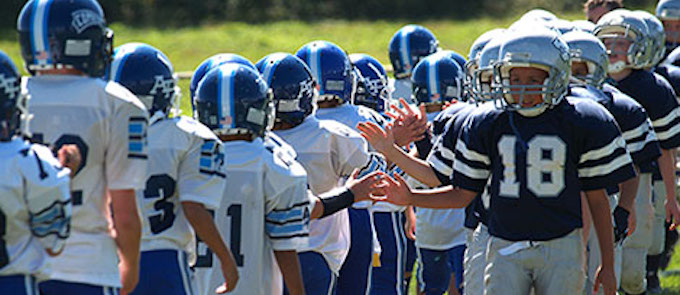
Within the white lines of the football field, the primary objective is to win. But at the youth football level, while winning is nice, there is a much deeper objective than winning or just having fun.
You simply can’t underestimate the importance of showing good sportsmanship. In youth football it must come from three sources: coaches, parents and players.
From a coach’s standpoint, there are so many responsibilities on a football team including teaching, equipment management, scheduling and trying to win. But a coach also has the responsibility to lead by example for his or her players and display good sportsmanship.
Don’t run up the score. With my son Bradley, I’ve seen it from both ends with his team. There have been games where things didn’t go well, and there have games where his Red Devils won in blowout fashion. It’s nice to build up a lead, but there are times when the coach has to call off the dogs. There’s no reason to embarrass other teams, especially those with kids that are still learning the game. There are some leagues that have special provisions when the score is lopsided. Aside from that, if you get a big lead, just run the ball up the middle. If the other team can’t stop you, then there’s nothing you can do. Just don’t rub it in.
Give everybody a chance. While it’s important to try to win, every kid on a team should get a chance to play. There’s no reason for any child to have a clean uniform at the end of the game. If they’re showing up for practice and coming to the games, let them play. Even for kids who do have a regular position, take advantage of a lopsided game to give them a chance at another position. The playoffs might be a different story. If you’re in the playoffs, you play to win. However, during the season, everyone plays.
In a way, it’s sad to have to say this, but parents need to show sportsmanship as well. Believe it or not, there are many of them who simply don’t. Just like the coaches, the parents (and other family and friends) need to set a good example. That means behaving properly at games and practice.
Let the coach do the talking. Once you bring your child to a game or a practice, he or she is now the responsibility of the coach. Barring any unusual circumstances, anything related to what happens on the field should be handled by the coach. When it comes to the officials at a game, they’re human and they make a bad call from time to time. Don’t verbally abuse the officials. Stay off the field. You could get yourself thrown out of the game or even banned from future games. Let the head coach deal with the official. A coach shouldn’t abuse the officials either, but he or she should be the only one discussing anything with them.
Cheer everyone at all times. Believe me: I know the feeling of wanting your child to do well in the game. I get more nervous at my son’s games that I do watching the Jets. But parents shouldn’t forget about the other kids on the team. As parents, you’re fans of the whole football team, so cheer just as hard when someone other than your child does well. I’ll admit that I’ve lost my mind on occasion when my son did something awesome, but I’ll also scream and yell when someone else on the team runs 80 yards for a touchdown.
It goes without saying that players need to have fun, play hard, and do what they can to help their team win. But you also have to show the proper sportsmanship
Have respect for the game, teammates and opponents. A player needs to play hard but also play the game the right way. Players should respect their opponents and not engage in any activity that could result in an unnecessary incident or injury. Players should be paying attention at all times. They shouldn’t be looking into space and picking grass. If you’re not in the game, stand on the sideline, take a knee, and cheer on your teammates. If you have the chance to, help a teammate or even an opponent get up from the ground after a play.
Win, lose or draw, the game of football is great. There are so many lessons to be learned from the game, such as teamwork, discipline and leadership. Perhaps the most important and maybe underrated aspect of the game is showing good sportsmanship.
As great as the game is, it’s a whole lot better with the coaches and parents not screaming at the officials, players cheering on their teammates, and two teams respecting each other and congratulating each other after a hard fought battle.

Peter Schwartz is an anchor and reporter for the CBS Sports Radio Network. He also writes a CBS New York sports blog athttp://newyork.cbslocal.com/tag/peter-schwartz/. You can follow him on Twitter pschwartzcbsfan. Peter’s son Bradley plays for the Levittown Red Devils of the Nassau Suffolk Football League on Long Island in New York. His son Jared cheers on Bradley and then Bradley returns the favor when Jared is playing soccer.