
 Email
Email Print
Print
.jpg "Share on twitter")
OFA Reads: Coaching Canadian Football
2018-02-22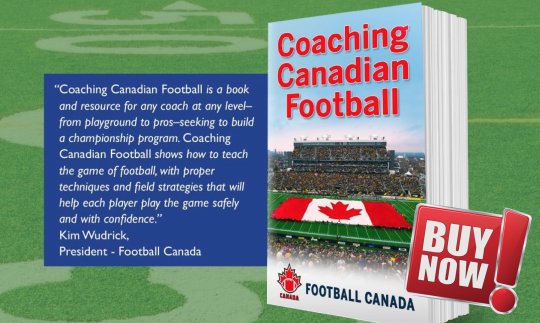
Ontario Football's Ryan Clutterbuck sat down with Ryan Hall (Campbell Collegiate - Regina, Saskatchewan) to talk about Football Canada's new book; Coaching Canadian Football.
Ontario Football Alliance is pleased to recommend Coaching Canadian Football to its members. Authored by football coaches from across Canada with Ryan Hall (Campbell Collegiate - Regina, Saskatchewan), Coaching Canadian Football is a collection of resources that can benefit coaches from all backgrounds and levels of competition. The book is organized with five categories, including fundamentals of coaching, individual skills and team tactics, game winning strategies, innovative and effective practice sessions, and program building and management. And it includes twenty-four chapters on topics like: leading a team; scouting the opposition; developing a competitive mental edge; planning and running an effective practice; watching game film; and building a high school program.
As part of the OFA Reads initiative, we invite our members to reflect on the ideas presented in Coaching Canadian Football – to improve the coaching and administration of football across Ontario. Recently, Ryan Clutterbuck (OFA) and Ryan Hall (Campbell Collegiate) talked about the book, and Hall’s coaching philosophy. An excerpt from that conversation is provided here:
Clutterbuck: I thought we could talk about Coaching Canadian Football
Hall: Absolutely. What do you think so far?
Clutterbuck: I’m enjoying it. I read your coaching philosophy chapter, which is excellent, and I read the safe contact chapter too.
Hall: What did you think of that?
Clutterbuck: I think it’s great that it’s in print for starters. If you’re a parent, or if you’re an administrator I think it’s a great resource to have, because not everyone is going to go through the Safe Contact training. But they should still be able to find out what’s being taught at the workshops and the techniques coaches are using today.
Hall: I think you’re right. And the technical side of tackling is so important. A lot of coaches haven’t had that training in the past. Hopefully that chapter can give them tools they can use and safer contact drills they can use as well.
Clutterbuck: I have another question for you. I imagine putting this book together would have been quite a learning process. What did you learn about football, or what stood out to you most as you compiled the chapters?
Hall: It was a lot like going to a coaches clinic. There’s a lot of reinforcement of what I already believed in when I read through many of the chapters, and there were others where I picked up some really good ideas. The chapter on the mental edge by Jay Hetherington for example. That’s a topic that I’m interested in because I teach performance psychology. And Jay has a different perspective from some of the ways I’ve approached it. Reading the chapters on building a program was also very interesting to me. Just to see the distinctions between junior football and CEGEP football and U Sports football. As a high school coach, some of those things are applicable as well.
Clutterbuck: It’s funny you bring up those chapters. Tom Sargeant’s was the first chapter I read (Chapter 23: Building a CJFL Program). I had the chance to travel to Saskatoon in 2012 and play the Hilltops when I was coaching the London Beefeaters, and since then I’ve been fascinated by junior football in western Canada.
Hall: What the Hilltops have going on is just so amazing. Their culture and their tradition and the values and how they’re able to create buy-in from the kids. They’ve always had to compete with the University of Saskatchewan Huskies, and they’ve been able to sell their program for decades. They’re definitely doing something right.
Clutterbuck: My next question has to do with your chapter on coaching philosophy. You take inspiration from different places, and you talk about taking time to develop your personal coaching philosophy. How has your philosophy evolved over time?
Hall: I think like most coaches, it started with the most influential coaches I had. I only played one year of high school, and played four with the Regina Rams after that. (Former Rams Head Coach) Frank McCrystal’s big thing was to always give back. Find ways to give back to the game. That’s something that stuck with me.
My position coach, Rick Seaman – it was how technical he was. He was so picky about every little detail about our footwork and body position, and that influenced me as well. Another influence on me was in my playing years we hardly ever lost. In five years of playing football we lost seven games. It was all very focused on winning and I was used to winning. When I started coaching, winning was super important.
I was coaching at a school where the kids didn’t have much football background. We were a smaller school – and we didn’t win very much. And as a result, I became a very negative coach in the first part of my career. I was always yelling and criticizing, and I was after the kids because we weren’t playing good enough and we weren’t winning. On top of that, I was at a Christian high school. And I struggled with that – am I acting like a Christian? Am I coaching like a Christian? And how should I do that? How do you coach a sport like football that’s aggressive and tough and physical?
A turning point for me was when I went to Norway with a few Christian coaches from the US to do football camps for their clubs. The coach who lead it was Tony Agresta, and he opened my eyes to how I could be myself and coach with intensity and do it the way I was supposed to – how God would want me to do it as a Christian. I was still intense and technical. But WHY I was coaching was different. My WHY had changed. And when you’re talking about developing a philosophy, that’s the bottom line question you have to answer – why am I doing this?
I was 31 at the time. It took me almost a decade of coaching before I was able to put it all together, and that was the experience that transformed my coaching and changed the direction of my coaching. After that I was a lot more thoughtful and purposeful and true to my values and who I was. That’s how I could benefit other people – that’s how I could leave the right impact and make the right difference. And winning was certainly not necessary to do it the right way, even though winning was something we wanted to strive for.
Clutterbuck: You briefly mention a Friendship Camp in your chapter on coaching philosophy. Can you speak a little more about that?
Hall: It’s been really cool. Last spring we went to a reserve that’s about an hour and a half east of Regina with eight or nine of our players. The plan was we’d go do some coaching workshops and practice with their team. Their team is less experienced, but they’re building a program, so we did the camp. We did the Safe Contact progression with them and we did a few practices focused on skill development.
Then, they gave us a cultural experience. They took us to their pow wow grounds and talked about the pow wow. They did some drumming and singing and told us about that. We did a smudge with them. Their elders talked to us about smudging and gave us what I would call a Life Talk. We talked about life and football and spirituality and how they’re related. And they treated us like gold.
And we didn’t want this to be a one time thing. We wanted to make it a relationship between our schools so that we could host them as well. It’s really evolved, and I’ve taken my performance psychology class there as well. We’ve brought their Chief to us – I had him come in and our kids really responded to his message.
And there’s a lot of tension in Saskatchewan right now as you’re probably aware. I’ve been texting back and forth with their Chief (who is also the football coach), because we’d like to continue the Friendship Camp. That’s the intention – is to try to build relationships and to make friends. That’s what we’re trying to do. And for us, the football team is a tool to do that. We’re using the experience of playing high school football to expand the life experiences of our players, and to me, this’ a pretty important part of life and of my coaching philosophy. It’s getting to know and understand and work with people that are different from you. To me, that’s the value of sport.
Clutterbuck: I have one more question if that’s alright. One of the things I like about Coaching Canadian Football is that coaches can go through it at their own pace. In fact, I’d argue it probably shouldn’t be read as a novel, but instead, one chapter at a time, with time for reflection and action. So, with that, I’ll ask you to reflect on what’s next for Coaching Canadian Football?
Hall: As I see it, the two biggest things we still need to address are coaching females and the development of female football, and coaching in First Nations communities. To me, those are the two biggest growth potential areas that we have in football, and we’re just barely scratching the surface. In Saskatchewan, women’s football is doing well and taking off and there’s growth, but we’d like to get more girls playing at younger ages.
Other areas that are also important are the development of the 6-a-side and 9-a-side games. We do both in Regina Minor Football, and when we started implementing them, the coaches were nervous. They felt insecure or ill-equipped. But it turns out, it’s the same game. It’s football. Still, I think those are areas that warrant more attention. And flag football as well. Flag and touch football are growing in popularity, and it makes sense to have future chapters devoted there.
Clutterbuck: Thanks Ryan. That’s it for my questions.
Hall: Thanks to you, Ryan. Always nice chatting with you and talking football.
As part of the OFA Reads initiative, we invite our members to reflect on the ideas presented in Coaching Canadian Football – to improve the coaching and administration of football across Ontario. Recently, Ryan Clutterbuck (OFA) and Ryan Hall (Campbell Collegiate) talked about the book, and Hall’s coaching philosophy. An excerpt from that conversation is provided here:
Clutterbuck: I thought we could talk about Coaching Canadian Football
Hall: Absolutely. What do you think so far?
Clutterbuck: I’m enjoying it. I read your coaching philosophy chapter, which is excellent, and I read the safe contact chapter too.
Hall: What did you think of that?
Clutterbuck: I think it’s great that it’s in print for starters. If you’re a parent, or if you’re an administrator I think it’s a great resource to have, because not everyone is going to go through the Safe Contact training. But they should still be able to find out what’s being taught at the workshops and the techniques coaches are using today.
Hall: I think you’re right. And the technical side of tackling is so important. A lot of coaches haven’t had that training in the past. Hopefully that chapter can give them tools they can use and safer contact drills they can use as well.
Clutterbuck: I have another question for you. I imagine putting this book together would have been quite a learning process. What did you learn about football, or what stood out to you most as you compiled the chapters?
Hall: It was a lot like going to a coaches clinic. There’s a lot of reinforcement of what I already believed in when I read through many of the chapters, and there were others where I picked up some really good ideas. The chapter on the mental edge by Jay Hetherington for example. That’s a topic that I’m interested in because I teach performance psychology. And Jay has a different perspective from some of the ways I’ve approached it. Reading the chapters on building a program was also very interesting to me. Just to see the distinctions between junior football and CEGEP football and U Sports football. As a high school coach, some of those things are applicable as well.
Clutterbuck: It’s funny you bring up those chapters. Tom Sargeant’s was the first chapter I read (Chapter 23: Building a CJFL Program). I had the chance to travel to Saskatoon in 2012 and play the Hilltops when I was coaching the London Beefeaters, and since then I’ve been fascinated by junior football in western Canada.
Hall: What the Hilltops have going on is just so amazing. Their culture and their tradition and the values and how they’re able to create buy-in from the kids. They’ve always had to compete with the University of Saskatchewan Huskies, and they’ve been able to sell their program for decades. They’re definitely doing something right.
Clutterbuck: My next question has to do with your chapter on coaching philosophy. You take inspiration from different places, and you talk about taking time to develop your personal coaching philosophy. How has your philosophy evolved over time?
Hall: I think like most coaches, it started with the most influential coaches I had. I only played one year of high school, and played four with the Regina Rams after that. (Former Rams Head Coach) Frank McCrystal’s big thing was to always give back. Find ways to give back to the game. That’s something that stuck with me.
My position coach, Rick Seaman – it was how technical he was. He was so picky about every little detail about our footwork and body position, and that influenced me as well. Another influence on me was in my playing years we hardly ever lost. In five years of playing football we lost seven games. It was all very focused on winning and I was used to winning. When I started coaching, winning was super important.
I was coaching at a school where the kids didn’t have much football background. We were a smaller school – and we didn’t win very much. And as a result, I became a very negative coach in the first part of my career. I was always yelling and criticizing, and I was after the kids because we weren’t playing good enough and we weren’t winning. On top of that, I was at a Christian high school. And I struggled with that – am I acting like a Christian? Am I coaching like a Christian? And how should I do that? How do you coach a sport like football that’s aggressive and tough and physical?
A turning point for me was when I went to Norway with a few Christian coaches from the US to do football camps for their clubs. The coach who lead it was Tony Agresta, and he opened my eyes to how I could be myself and coach with intensity and do it the way I was supposed to – how God would want me to do it as a Christian. I was still intense and technical. But WHY I was coaching was different. My WHY had changed. And when you’re talking about developing a philosophy, that’s the bottom line question you have to answer – why am I doing this?
I was 31 at the time. It took me almost a decade of coaching before I was able to put it all together, and that was the experience that transformed my coaching and changed the direction of my coaching. After that I was a lot more thoughtful and purposeful and true to my values and who I was. That’s how I could benefit other people – that’s how I could leave the right impact and make the right difference. And winning was certainly not necessary to do it the right way, even though winning was something we wanted to strive for.
Clutterbuck: You briefly mention a Friendship Camp in your chapter on coaching philosophy. Can you speak a little more about that?
Hall: It’s been really cool. Last spring we went to a reserve that’s about an hour and a half east of Regina with eight or nine of our players. The plan was we’d go do some coaching workshops and practice with their team. Their team is less experienced, but they’re building a program, so we did the camp. We did the Safe Contact progression with them and we did a few practices focused on skill development.
Then, they gave us a cultural experience. They took us to their pow wow grounds and talked about the pow wow. They did some drumming and singing and told us about that. We did a smudge with them. Their elders talked to us about smudging and gave us what I would call a Life Talk. We talked about life and football and spirituality and how they’re related. And they treated us like gold.
And we didn’t want this to be a one time thing. We wanted to make it a relationship between our schools so that we could host them as well. It’s really evolved, and I’ve taken my performance psychology class there as well. We’ve brought their Chief to us – I had him come in and our kids really responded to his message.
And there’s a lot of tension in Saskatchewan right now as you’re probably aware. I’ve been texting back and forth with their Chief (who is also the football coach), because we’d like to continue the Friendship Camp. That’s the intention – is to try to build relationships and to make friends. That’s what we’re trying to do. And for us, the football team is a tool to do that. We’re using the experience of playing high school football to expand the life experiences of our players, and to me, this’ a pretty important part of life and of my coaching philosophy. It’s getting to know and understand and work with people that are different from you. To me, that’s the value of sport.
Clutterbuck: I have one more question if that’s alright. One of the things I like about Coaching Canadian Football is that coaches can go through it at their own pace. In fact, I’d argue it probably shouldn’t be read as a novel, but instead, one chapter at a time, with time for reflection and action. So, with that, I’ll ask you to reflect on what’s next for Coaching Canadian Football?
Hall: As I see it, the two biggest things we still need to address are coaching females and the development of female football, and coaching in First Nations communities. To me, those are the two biggest growth potential areas that we have in football, and we’re just barely scratching the surface. In Saskatchewan, women’s football is doing well and taking off and there’s growth, but we’d like to get more girls playing at younger ages.
Other areas that are also important are the development of the 6-a-side and 9-a-side games. We do both in Regina Minor Football, and when we started implementing them, the coaches were nervous. They felt insecure or ill-equipped. But it turns out, it’s the same game. It’s football. Still, I think those are areas that warrant more attention. And flag football as well. Flag and touch football are growing in popularity, and it makes sense to have future chapters devoted there.
Clutterbuck: Thanks Ryan. That’s it for my questions.
Hall: Thanks to you, Ryan. Always nice chatting with you and talking football.